
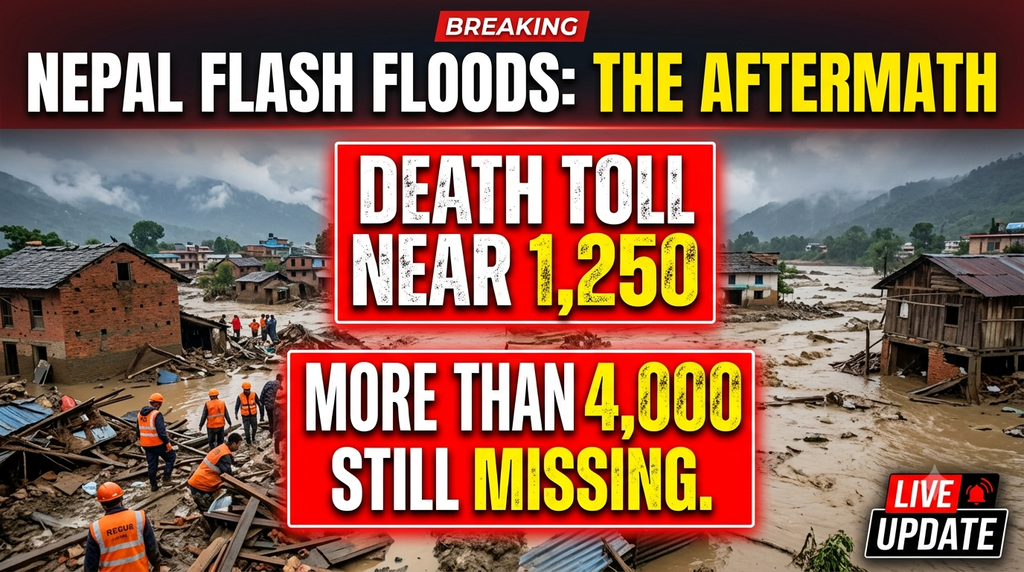
Nepal is facing a devastating humanitarian crisis after a catastrophic flash flood swept through communities near the Nepal–China border on August 26, 2026. More than a week after the disaster, rescue teams are still searching through massive amounts of mud, rock, ice and debris for survivors.
According to Nepal’s disaster management authorities, at least 1,252 people have died and more than 4,200 remain missing. The disaster has destroyed homes, roads, bridges and hydropower infrastructure across several affected districts.
The tragedy has also affected people from outside Nepal. Hundreds of foreign nationals, including pilgrims and trekkers, remain unaccounted for.
What Caused the Nepal Flash Flood?
The disaster began on August 26, when a massive collapse of ice, rock and mud in the Himalayan region sent a huge volume of water and debris downstream.
The resulting flood travelled through river valleys with extraordinary force, destroying settlements and critical infrastructure. The worst-affected areas include parts of Rasuwa, Nuwakot, Dhading, Chitwan and Nawalparasi East.
Scientists have linked the disaster to a suspected glacial collapse. Researchers have also warned that rising temperatures and changing conditions in the Himalayas can destabilize ice and rock formations, potentially increasing the risk of cascading mountain hazards. However, climate change should not be considered the sole confirmed immediate trigger for this particular event.
Death Toll and Missing People
The human cost continues to rise as rescuers reach areas that were previously inaccessible.
As of September 3:
- 1,252 people have been confirmed dead in Nepal
- More than 4,200 people remain missing
- More than 583 foreign nationals are among those reported missing
- Around 7,500 houses have been completely destroyed
- Authorities estimate that approximately 20,000 homes may eventually need to be rebuilt
- About 22,000 children urgently require safe water, sanitation and hygiene support
- Nearly 4,000 displaced people are staying in relief centres
Across the border in Tibet, Chinese authorities have reported 21 deaths and 541 missing people.
Because search operations are still underway, casualty and missing-person figures may continue to change.
Rescue Operations Continue
More than 9,300 Nepali Army personnel have been deployed to the affected areas. Their work includes searching for survivors, recovering bodies, clearing roads, providing emergency medical assistance and helping restore access to isolated communities.
International teams are also assisting Nepal. Experts and rescue personnel from countries including India, China, South Korea and Australia have contributed to search, rescue and humanitarian operations.
One of the most difficult challenges is locating people believed to be trapped inside tunnels associated with hydropower projects.
Hydropower Tunnels Become a Major Focus
Several hydropower projects were severely damaged by the flood.
Authorities believe that around 900 people may still be trapped or missing in areas associated with hydropower tunnels. At the Rasuwagadhi hydropower project, officials said they believed 46 workers could still be alive inside a chamber because they may have access to food and water.
Rescuers face enormous obstacles. Tunnels and access points have been filled with mud and debris, making it extremely difficult for heavy machinery and rescue teams to reach possible survivors.
The search is continuing despite the passage of more than a week.
Thousands of Homes Destroyed
The disaster has fundamentally changed entire communities.
Nepalese authorities estimate that approximately 7,500 houses were completely destroyed, either washed away or buried under mud and debris.
But the damage goes beyond houses. Roads, bridges, schools, electricity infrastructure and hydropower facilities have also suffered extensive damage.
Authorities estimate that roughly 20,000 homes may eventually have to be rebuilt in safer locations rather than reconstructed where they previously stood.
For survivors, the question is no longer simply how to rebuild—it is where it is safe to rebuild.
Life in Relief Camps
Thousands of survivors have been moved into temporary shelters and relief centres.
Although food and other essential supplies are being distributed, some people are struggling to access medicines, cash and other necessities.
The situation illustrates the difference between immediate disaster relief and long-term recovery. A person may receive food and shelter but still have difficulty obtaining prescription medicines, replacing lost identification documents or accessing employment and income.
In some areas, residents have even been using temporary zip lines to cross damaged sections of the Trishuli River, demonstrating how communities are adapting to destroyed roads and bridges.
The Search for Missing Loved Ones
One of the most heartbreaking aspects of the disaster is the uncertainty surrounding thousands of missing people.
At Kathmandu’s Tribhuvan University Teaching Hospital, families have been looking through photographs of unidentified bodies and missing people in the hope of finding information about relatives.
For many families, there has been no confirmed news—only waiting.
Some families have even begun holding symbolic funerals for relatives who are presumed dead after days of unsuccessful searches. Others continue to hope that their loved ones will be found alive.
Foreign Nationals Among the Missing
The disaster has also affected international visitors travelling through the region.
Nepal’s Foreign Ministry has reported hundreds of foreign nationals missing, including pilgrims and trekkers from multiple countries. Some missing tourists have subsequently made contact with authorities, providing occasional positive news amid the wider tragedy.
The presence of foreign nationals has also increased international attention on the rescue effort.
Governments and organizations from several countries are providing assistance, personnel, equipment and logistical support.
Nepal Faces a Massive Reconstruction Challenge
The rescue operation is only the first stage.
Once the immediate emergency ends, Nepal will face a huge reconstruction challenge.
The country will need to rebuild:
- Homes and residential communities
- Roads and bridges
- Schools
- Electricity infrastructure
- Hydropower facilities
- Water and sanitation systems
- Communication networks
- Emergency-response infrastructure
But rebuilding exactly what existed before may not be enough.
Communities located along vulnerable river corridors may need to be relocated to safer areas, particularly where homes have been completely destroyed or where the underlying terrain remains unstable.
The disaster has therefore raised an important question for Nepal’s future: Should reconstruction focus on replacing damaged infrastructure—or on redesigning communities to withstand future disasters?
Early-Warning Systems May Become Critical
The disaster has also highlighted the importance of early-warning systems in the Himalayan region.
Nepal is reportedly planning to rebuild and strengthen monitoring infrastructure along parts of its border with China. Proposed measures include seismic sensors, cameras and satellite-based communication systems capable of continuing to operate when conventional communication networks fail.
Such systems may provide communities with only a few minutes of warning in some scenarios, but even a short warning could potentially allow residents to evacuate vulnerable river valleys.
Better sharing of information about glacier movement, upstream water levels and mountain hazards between neighbouring countries could also improve preparedness.
Why the Nepal Disaster Matters Beyond Nepal
The tragedy is a warning for the entire Himalayan region.
The Himalayas contain thousands of glaciers, steep mountain slopes and rapidly changing climatic conditions. Communities downstream are exposed to hazards including:
- Glacial lake outburst floods
- Landslides
- Flash floods
- Rock and ice avalanches
- Debris flows
- Earthquakes
- Extreme rainfall
As infrastructure development expands into mountain valleys, the potential consequences of a major natural hazard can become even greater.
Hydropower projects, roads, bridges, tourism facilities and settlements all need to account for these hazards during planning and design.
A Long Road Ahead
For Nepal, the immediate priority remains clear: find survivors, recover the missing, provide medical care and support displaced families.
But the longer-term task will be even more complicated.
Thousands of families will need permanent housing. Children will need schools. Roads and bridges will have to be rebuilt. Damaged hydropower projects will require assessment. Communities in high-risk locations may need relocation.
Most importantly, Nepal will need to strengthen its disaster preparedness so that future floods do not produce the same level of devastation.
The August 26 disaster has already left a deep human and physical scar across the region. With more than 1,250 deaths and over 4,200 people still missing, the full scale of the tragedy is still unfolding.
For the families waiting for news, however, the rescue operation is not yet over.
The search continues.
Nepal Flash Floods: Key Facts at a Glance
| Item | Latest reported figure |
|---|---|
| Date of disaster | August 26, 2026 |
| Nepal deaths | 1,252+ |
| People missing in Nepal | 4,200+ |
| Foreign nationals missing | 583+ |
| Houses completely destroyed | 7,500 |
| Homes potentially requiring rebuilding | ~20,000 |
| Children requiring WASH support | 22,000+ |
| Nepali Army personnel deployed | 9,300+ |
| People potentially trapped/missing around hydropower tunnels | ~900 |
| Tibet deaths | 21 |
| Tibet missing | 541 |
Figures are based on the latest reports available on September 3, 2026 and may change as search and identification operations continue.
Sources
- Reuters – Nepal must rebuild thousands of homes, no let up in search for missing
- Reuters – Nepalis pin hopes on ‘wall of the missing’ in hunt for relatives
- AP News – Trading food for medicine and crossing the river by zip line
- Reuters – Nepal to rebuild early-warning system on China border

D Singha is a Civil Engineer with expertise in bridge design, structural engineering, and infrastructure projects. He shares insights on engineering, construction practices, technology, and professional development.