Contents
Box culverts are commonly used in highway and railway projects to allow water to pass beneath embankments. When vehicles move over the embankment above the culvert, their wheel loads must be transferred safely to the structure. One important concept used in design is load dispersion through the earth fill above the culvert slab.
Load Dispersion Through Earth Cushion
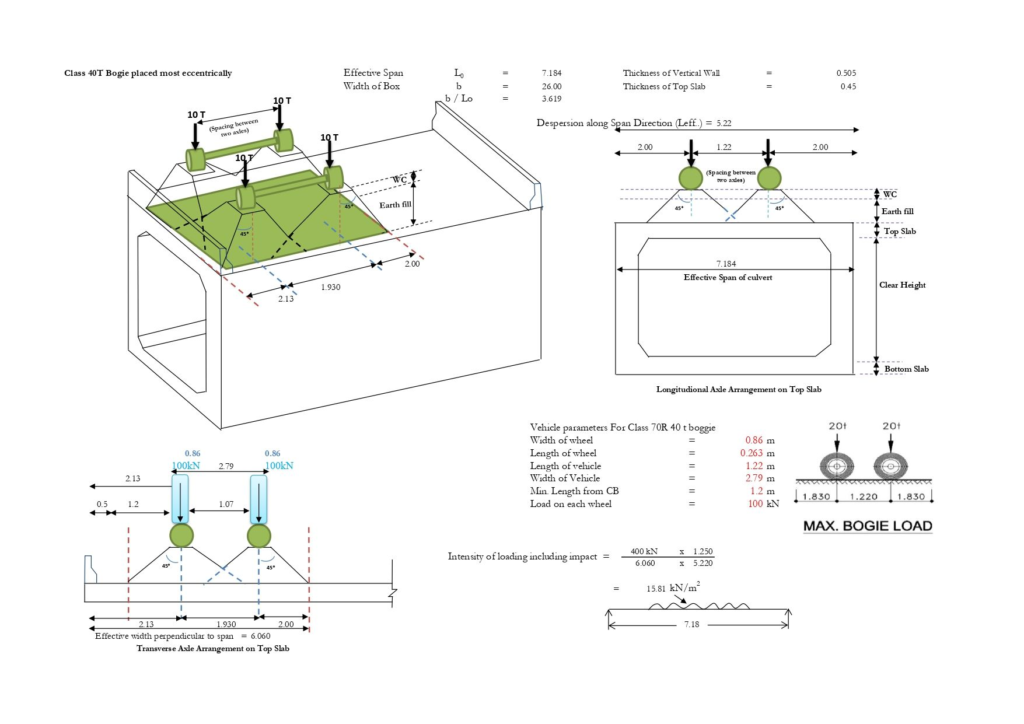
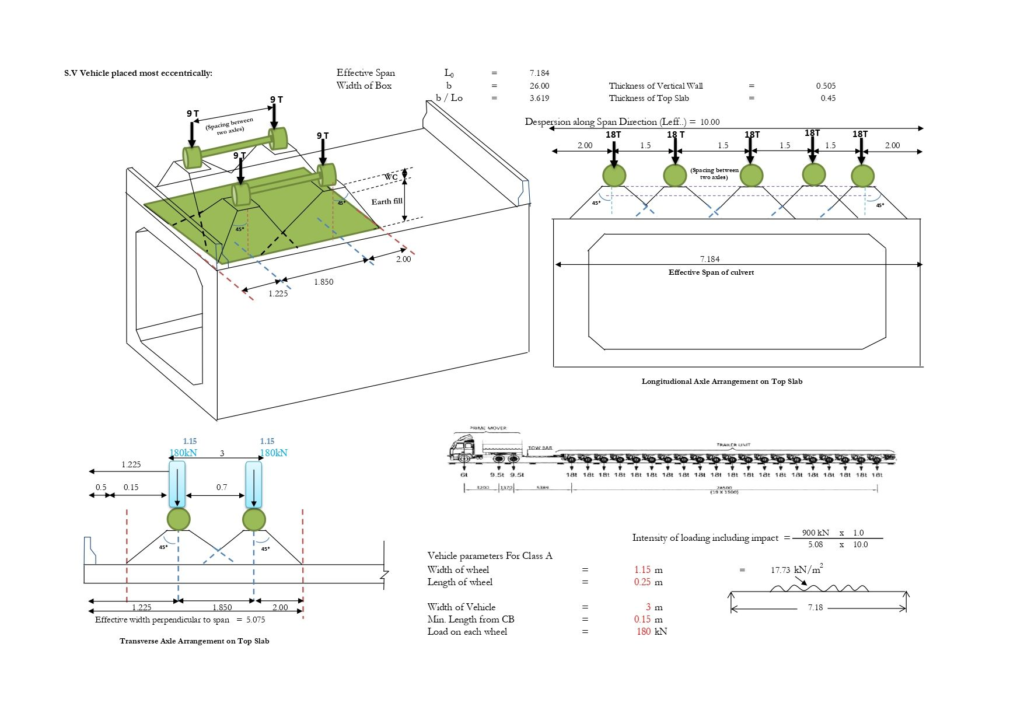
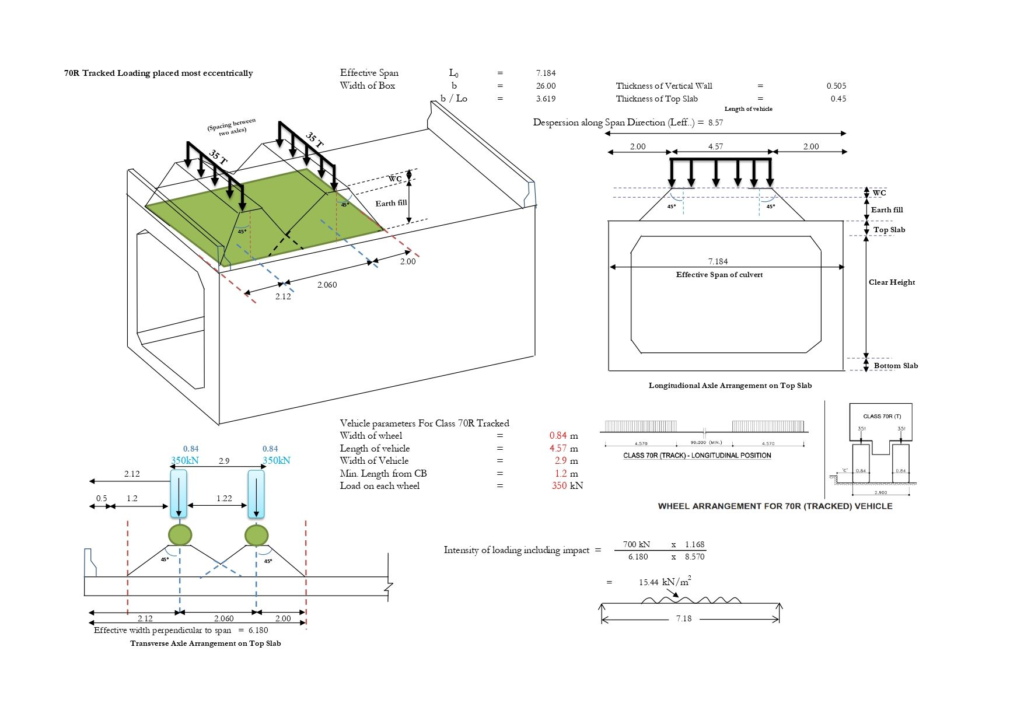
When sufficient earth fill (cushion) is present above the top slab of a box culvert, the wheel load does not act directly on a small area of the slab. Instead, the load spreads through the soil before reaching the structure.
According to IRC 112 provisions, the wheel load is assumed to disperse through the embankment at an angle of 45°, which corresponds to a 1 Vertical : 1 Horizontal (1V:1H) distribution.
This means that as the load travels downward through the soil, the effective contact area increases, reducing the intensity of the load acting on the culvert slab.
Effect on Structural Design
Due to this load dispersion:
- The effective load width at the slab level becomes larger than the tyre contact area.
- Load intensity decreases because the same load is distributed over a larger area.
- Bending moments and shear forces in the top slab are reduced compared to direct wheel loading.
The effective width of the load at slab level depends mainly on the height of the earth cushion above the culvert. Greater fill height results in greater load dispersion.
Case When Earth Cushion is Not Present
The 45° load dispersion assumption is valid only when sufficient earth fill is available above the culvert slab.
If the road surface is directly over the slab with little or no earth cushion, the wheel load acts almost directly on the slab. In such cases:
- Load dispersion through soil is negligible.
- The load should be considered within the tyre contact area, as specified in design codes.
This condition generally results in higher bending moments and shear forces in the slab.